Local Highlight this week: 17 March - 25 March, 2014
Annual Rathotsava at Devi Mookambika Temple, Kollur
Kollur is a small temple-town situated about 80 km from Udupi & about 120 kilometres away from Shimoga City in Karnataka . This village lies at the foot of the Western Ghats and is famous for the Mookambika temple.
 |
| Maha Dwara at Kolluru |
Mookambika Temple at Kollur, is one of the most important places of pilgrimage on the west coast, attracting pilgrims from all over the country. The temple, dedicated to Goddess Mookambika, stands in the valley of the great Kodachadri peak, on the banks of the perennial river Souparnika.
The goddess is called Mookambika as she is said to have slain the demon Mookasura. The main idol, is in the form of a Jyothirlinga incorporating both Shiva and Shakti, and is placed in front of the image of Mookambika. It is divided by a golden line into two unequal parts, the greater representing the three Goddesses, Mahalakshmi, Mahasaraswati, Mahakali, and the smaller Brahma, Maheshwara, and Vishnu. The Divine Mother is said to be a manifestation of ‘Tri-gunas’ or triple forms.
Use the links below to jump directly to the respective sections of this blog.
6.FESTIVALS AT KOLLUR
The Linga at the temple is said to have come into existence when Shiva drew the Chakra with his toe. This Chakra is believed to be the Udbhava linga which has drawn its strength due its proximity to all divine beings – Swayambu or autogenetic. It is also very sacred since Kollur Devi is supposed to have merged with this Swayambulinga to acquire great power.
Here she is said to have formed part of Linga along with Lakshmi and Saraswathi on one side and Lord Brahma, Vishnu and Parameshwara on the other side. There is also a carved idol of Shiva, said to be injured during the clash with Arjuna - known as Kiratharjuna and this is on the right side of this Swayambulinga.
Adi Shankaracharya is believed to be instrumental in Mookambika taking this place Kollur as her abode. It is this place, near the bank of Souparnika River, that he stopped to fix the Chakra and on above it placed the Devi. This forms the central idol behind the Linga. This temple has been patronized by many ancient kings who have donated precious jewels to Sri Kollur Devi which are still adorned by her, since the temple was believed to be the state temple in those days.
Kollur is an important seat of Shakti worship. The temple is rich in puranic lore.
Legend goes that a Sage Kola was enchanted with nature’s beauty and decided to perform a penance on a rock near the Agnitheertha. Lord Shiva appeared before him and blessed him. The sage wished for the welfare of mankind and nothing else. The Lord, delighted with Kola, assured him that a Swayambulinga would appear for him to worship. However, Kola wanted to worship Devi also. A swarna rekha (gold line) then appeared on the Linga, signifying Shakti. Thus, Shiva and Shakti are worshipped together in the Linga. Besides this, a unique feature is that the other Gods and Goddess of the Hindu pantheon also believed to reside in a-roopa (non-form) in the Linga. It is thus believed to be an abode of the entire celestial congregation.
It is said that Adi Shankara meditated at Kodachadri hills and Devi incarnated before him. He wished to install the Devi idol in a place so he could worship her wherever he wanted. Devi agreed but put forward a challenge that she would follow Shankara provided he does not look back until he reached his final destination. To test Shankara, Devi deliberately stopped the sound of her anklets when they reached Kollur whereupon he turned and looked back in doubt. Devi then asked him to install her vigraha, just as he sees her, at that very location in Kollur.
Another legend says that original temple is at Kodachadri peak which is at a distance of about 20 km from Kollur. The large mountain peak is visible in front of the temple. On the Kodachadri peak, a small temple dedicated to Mookambika is present.

Long ago, a demon called Kaumasura obtained a boon from Lord Shiva to never be destroyed by any other being in the world. Kodachadri became the hiding place for all the gods and divine beings who were helpless against his harassment. While the Saptarishis were engaged in prayers and poojas to bring about the end of demon, Guru Shukracharya enlightened him about his impending death at the hands of a woman. Learning of this, Kaumasura performed an austere penance to please Lord Shiva pleased with his prayers appeared before him and asked him to name the boon that he wished for. Vagdevi, the Goddess of speech sensed that this could lead to a greater devastation and made the demon speechless. The dumb Kaumasura was then unable to verbalise his wishes and thus came to be known as Mookasura. Soon after, on the request of Kola Rishi, the goddess created a mystical power by bringing together the individual powers of all the gods who had assembled. This Divine Power waged a war on Mookasura to bring about his destruction, thereby granting him salvation. The place where Devi killed Mookasura is known as ‘Marana Katte’. Since that day, the Goddess has resided at this holy place Kollur by the name Mookambika, fulfilling the wishes of all her devotees. Sreedevi resides here in the Padmasana posture, of a serene countenance, with 3 eyes, bearing always a shankha (conch), a chakra (wheel) and with a pleasant appearance to bless the devotees.
The history of idol installation at Kollur Mookambika temple is nearly 1200 years old. King Halugallu Veera Sangayya is said to have laid the valuable stone to cover the inside premises and this was done by him under the instructions of Rani Chennamaji.
The temple comprises of the sanctorum, a hall and the Lakshmi Mantapa at the rear. This Lakshmi Mantapa has four pillars each about 135 feet long. These are adorned with splendidly carved images of Indian deities. The beautiful sculptures are figurines of various Gods and Goddesses such as Ganesha, Subrahmanya, Naga, Mahishasura Mardini and the Devi in various forms.
The Garbagriha at this temple is contemporary and artistic in value. A huge deepasthambam stands tall with its base like a tortoise’s head. This Deepasthamba has 21 beautiful concentric circles which appear similar to that of Makara jyothi when all the lamps are lit and viewed from distance.
The temple has a gold plated crest and copper roofs, and a temple dome and kalasha made of solid gold. The shikhara of the temple which is well gilded with gold is said to have been donated by Sankanna Savantha. Around the chief shrine of Mookambika, there are many other shrines.
The Navrathri festival begins with an invocation to Lord Ganesha who is on this pillar. As we move inside the corridor beyond the Garbhagriha there are four types of idols of Ganapathi. Among them are Dasa bhuja Ganapathi and Balamuri Ganapathi which is beautifully sculpted using white marble.
Idol of Nagadevathe - a serpent that is worshipped by all Devi’s devotees in order to wade off the evil effects of Sarpodosa and other doshas. And it is believed that when touched while offering prayers, the devotees are said to be blessed with good fortune.
The outer side of the pradikshana we see the idol of Lord Muruga followed by the idol of Saraswathi, Pranalingeswara, Prartheshwara and Mukhya Prana. This Mukya Prana is placed just opposite to Veerabhadrasamy shrine to strike a balance for its dangerous appearance. Veerabadrasamy is said to be the presiding deity here.
DEVI’S EXQUISITE JEWELLERY
Kollur Devi adorns some exquisite ornaments that has been donated by ardent devotees - among them are Gundu Rao the ex-Chief Minister of Karnataka who has donated to Devi a silver sword. The legendary Rani Chennamma offered precious emerald which is still adorned by her till date. Late M.G. Ramachandran, former Chief Minister of Tamil Nadu also has gifted a golden sword to Sri Mookambika as a token of gratitude and as an ardent devotee. The Vijayanagaram king Krishnadevaraya presented Kollur Devi with a gold mask which is now considered very valuable. Chennamaji of Keladi gifted a gold face for Lingam that is also said to be of great value.
The main festival in the temple is the Rathothsava, the car festival, in the month of Phalguna (March-April). Thousands of devotees from different parts of the state and the country visit Kollur to pay obeisance to the Goddess on this auspicious occasion. On the day of the Uthara Nakshatra in the Bright half of the month, the temple flag is hoisted and the care festival continues from that day to the day of the Moola Nakshatra – for 9 days. Surrounded by the majestic mountains and the blooming forest with varied hues and fragrance, the shrine of Sri Mookambika invokes joy on the occasion. Thousands join the Rathothsavam, by drawing the great chariot of the Divine Mother, symbolizing the need of a joint effort of mankind to bring about a new civilization based on a higher spiritual vision of life. The temple festivals suggests that man should make these inner depths a great centre of festivity, of the joy of Self-discovery. He has to make his mind a pit of Yajna fire of selfless work. He has to offer the negativity of his selfishness in that fire. From that fire will manifests the Divine Goddess, the all-loving Supreme and who allays all fears.
Read more about the 9 day celebration here: http://www.mookambika.co.in/festivals.htm

 |
| The Chariot/ Ratha |
On the bright half of the Jyeshta month (June – July) on the Ashatmi day, is a special festival – this day is considered the day of the appearance of the Goddess. Special pooja is performed in the days of Mahaalakshmi Vratham, Mahaa Shivaraatri, Sri Krishna Jayanthi, Vinaayaka Chaturthi, Jyesta Lakshmi Vratham, etc.
Sri Mookambika Temple celebrates various festivals and regularly conducts Pancha Pooja and Thrikala Bali. Various celebrations of the temple can broadly be classified as Nithyothsavam, Varothsavam, Pakshothsavam, Masothsavam, and Varshikothsavam.
The main festival in the temple is the car festival, in the month of Phalguna (March-April). The Navarathri, the nine nights in the autumn (September-October), is a very auspicious occasion when thousands visit the temple. The special rites during this period are the Navakshari Kalasam, the Chandika Homam, the Rathothsavam, the Purnakumbha-abhishekam etc.
There is a very colourful festival Vana Bhojana, in November December, when during night the festival idol of Devi is carried by a decorated and colourfully illuminated country craft across the Souparnika and offered worship in the forest. There is a feast for all on the next day at the river bank amidst the forest scenes.
 The source of this river Souparnika is from the Kodachadri hills which offer a backdrop to the temple. The mythology about this temple and river says that a Garuda named Suparna performed penance on this river bank in order to save his mother from the continuous misfortunes and sorrows. Then the Kollur Devi appeared before him to grant her good wishes and at this juncture this garuda requested Devi that this river be named after him hence forth and thus this river came to be known as river Souparnika.
The place where the Suparna garuda sat is popularly known as Garuda caves. This river is joined by two more rivers downstream. They are known as Bhrungisha and Pippalada – they now fall under the Oluru region. There after it flows west ward to meet the sea near the Maharajaswamy temple.
This river is said to be not only holy but also to contain rich extracts of valuable herbs as it passes through many mountains that has abundant herbs and rare plants.
 |
| River Souparnika on the left and the Sea on the right. NH17 near Maravanthe, on the way to Kollur |
 |
| Path leading to Sarvajna Peeta, Kodachadri |
By Road: 3 hrs Approx
Mangalore city is only 50 km away from Udupi. Express buses ply between Mangalore to Udupi at regular intervals. You can reach Kollur by bus from Udupi.
By Rail The railway station at Udupi falls on the Konkan Railway network and there are trains from most major cities of the state. From Upudi you can reach Mookambika temple by bus or by taxi easily.
By Air
The nearest airport is the Mangalore airport located at Bajpe, 60 km away from Udupi. There are 2 flights everyday from Mumbai, Bangalore and from other parts of India.
Note to our readers: The information presented in this blog has been collated from various sources on the internet and hence Bangalore Press does not vouch for the authenticity of the same. We request you to write to us at if you think you can help us improve this article. You'll be given due credit for any information/images you provide us.
Write to us at: bangalorepressblog@gmail.com
Thank you!
References:
Image Sources:
omshivashakti.wordpress.com
kollur.com
 Chamarajanagar is a town in the southern end of Karnataka. It is also the headquarters of the Chamarajanagar district of Karnataka. It is named after Chamaraja Wodeyar IX (1774–1796), king of Mysore, who was born in the town.


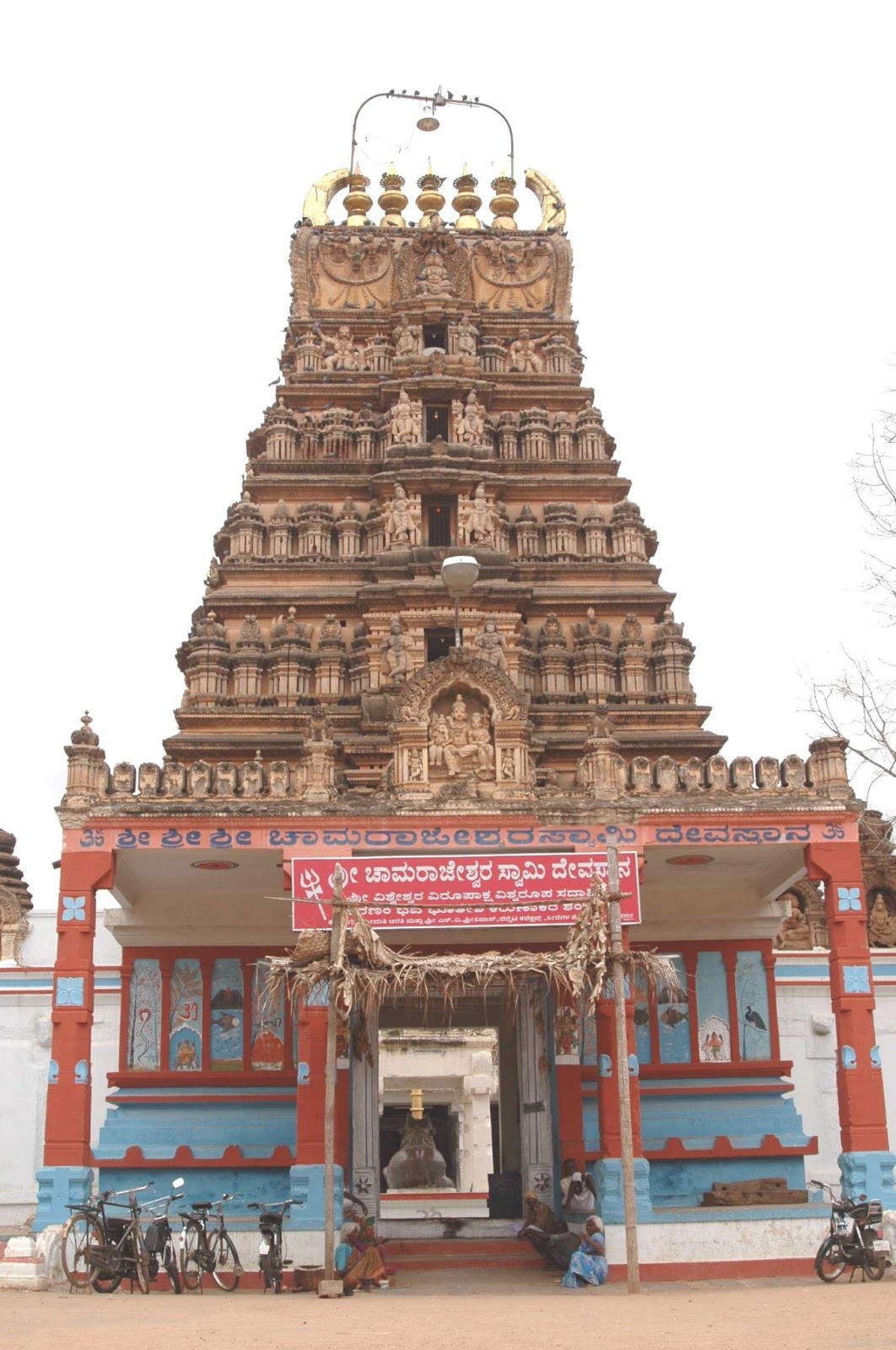
 The color used for paintings were prepared by the Blue, Red and Yellow stones with a mixture of diamond Gum after crushing the stones to find powder. The color in stucco figures will last long time and can be witnessed even today at many temples in Mysore region including Chamarajeshwara temple. While a majority of the paintings are in a sad state of affairs some still carry the tinge of delicacy and softness, discernible only to shrewd eyes.


