Showing posts with label Bangalore Press Blog. Show all posts

Sunday, 8 September 2013

How to perform a simple Ganesha Chaturthi Puja at Home?

Ganesha Chaturthi or Vinayaka Chaturthi is one of the most colorful and widely celebrated festivals in India. Large number of people observe Ganesha Chaturthi poojas at home. Here is an explanation on how to perform Ganesha puja at home as mentioned in Hindu scriptures.
Ganesha puja on the Chaturthi day is usually performed at noon but nowadays people perform it when all the family members are present. 

Requirements

  • A Clay image of Lord Ganesha.
  • Red flowers
  • Druva Grass blades
  • Modak (jaggery filled sweet)
  • Coconut
  • Red chandan (Sandalwood paste)
  • Incense and agarbathis


The Puja

  • First clean the house and take a bath.
  • A Clay image of Lord Ganesha is installed in a raised platform.
  • Pray to Lord Ganesh and you can recite mantras or bhajans dedicated to Lord Ganesha.
  • Next step is to invoke Ganesha into the image. This is known as pran-prathishta. The Pran Prathista mantra in Sanskrit to be invoked is found in the Rig Veda and is part of Ganesh Suktha.

ganananh tva ganapatim havamahe kavim kavinam - upamashravastamam |
jyeshhtharajam brahmanan.h brahmanaspata A nah shrivnvannutibhih sida sadanam || 
(Rig Veda 2.23.1)

ni shhu sida ganapate ganeshhu tvamahurvipratamam kavinam |
na rite tvat.h kriyate kinchanare mahamarkam maghavan.h chitramarcha || 
(Rig Veda 10.112.9)

We invoke You, O Ganapati of the ganas (Lord Shiva attendants), Who are Brahmana-spati of the brahmas (prayers), the wisest among the wise, Who abound in treasure beyond all measure, the most brilliant one. Do listen to our prayers, come with Your blessings and assurances of protection into our home, and be seated. (Rig Veda 2.23.1)

Sit down among the worshippers, O Ganapati, the best sage among the sages. Without You nothing can be done here or far. Accept with honor, O wealthy One, our great and variegated hymns of praise. (Rig Veda 10.112.9)

  • Now Ganesha is installed in the idol and one can perform arati and light the lamps. Some people perform the shhodashopachara, which are 16 forms of paying tribute to Ganesha. (This ritual is usually performed by the priests, you can skip this.)
  • Offer 21 blades of Druva Grass.
  • Offer 21 modakas
  • Offer red flowers
  • Apply a tilak using red Sandalwood paste.
  • Break the coconut or just keep it along with the idol. You can also keep fried grains. (The food of the rat – the vehicle of Ganesha).
  • You can also recite the 108 salutations dedicated to Lord Ganesha or read the Ganesha Upanishad or just simply pray.
The number 21 signifies - the five organs of perception, five organs of action, five vital airs (pranas), five elements, and the mind.

While performing Ganesha Puja at home, you can always be flexible. The strict rituals are meant for Vedic priests. All you need to be careful is to perform the pujas with a clean body and clean mind.

What is more important is devotion not the ritual.

Try to be simple. Concentrate on your prayers not on decoration and other ritualistic details.

Tuesday, 20 August 2013

Lord Hayagriva

The incarnation of Lord Vishnu with a Horse Head

Hayagriva is an incarnation of Hindu God Vishnu with a horse head. The main purpose of this incarnation of Vishnu was to recover the Vedas, which were stolen by Asuras or Demons. In this incarnation, Vishnu is worshipped in a human body with a horse head. An important temple where the Hayagriva murti is worshipped is the Hayagriva MadhavaTemple at Hajo in Assam. 

In Hindu scriptures there are two important 
legends relating to the incarnation of Hayagriva. The origin of Hayagriva Avatar is dealt in the ‘Shantiparva’ of Mahabharata and the Puranas.

In one legend, Kashyapa Prajapati had a son named Hayagriva which means ‘one with a horse’s head.’ Through intense austerities he pleased Goddess Durga and attained the boon that he will only be killed by another Hayagriva. With this new found strength, Hayagriva started creating mayhem in the world. Devas approached Vishnu to rescue the world and he readily agreed. 

A terrific battle ensued between Vishnu and the demon. But with Goddess Durga boon to his aid, Hayagriva could not be killed. Vishnu left the battlefield to take rest. He went to Vaikunta and started meditating with his head supported by his bow. Devas were worried at Vishnu leaving the battlefield and entering into a long meditation. They looked out for ways to wake him up and finally sort the help of termites to eat away the bow.  While the termites were eating the bow, the string snapped and Vishnu’s head was severed. The entire universe trembled and Devas took refuge in Goddess Durga.

A smiling Goddess Durga – who knew what Vishnu was up to – asked the Devas to attach a head of a horse on Vishnu. Brahma did the auspicious deed and now Vishnu was Hayagriva. He went to the battlefield and fought demon Hayagriva and killed him.

In another legend, Lord Vishnu took the form of a horse and restored the Veda that was stolen from Lord Brahma by the demons Madhu and Kaitabha. As lord Vishnu took the form of a horse, this incarnation is called Hayagriva (the horse-head). After Vishnu created lord Brahma, he taught Brahma the all eternal Vedas. Once lord Brahma had mastered the Vedas, he was filled with pride that he was the only entity that had the knowledge of the all eternal and holy Vedas. 

Lord Vishnu thought otherwise and created demons Madhu and Kaitabha from two water drops on the lotus that he mounts. He then instructed them to steal the Vedas from Lord Brahma and hide it. Thus, Lord Brahma was in a fix that he was not able to save the holy and all eternal Vedas from theft and prayed to Lord Vishnu to do the needy. Lord Vishnu took the form of Hayagriva or Hayavadana and restored the all pervading Veda to safety, thus curbing the pride of Brahma. So the day of upakarma is also celebrated as Hayagriva Jayanthi. As the Vedas were restored on this day, Upakarma is performed on this day to mark a new beginning.

Hayagriva is also the name of an important Buddhist deity. An important temple dedicated to Lord Hayagriva is the HayagrivaMadhava Temple at Hajo in Assam.

Monday, 12 August 2013

Mangala Gowri Puja

How to Observe Mangala Gowri Puja?

Mangala Gowri Puja, or Shravana Mangala Gowri Puja, is an important Vratha observed by married women in Karnataka, Andhra Pradesh and by some communities in Maharashtra. It is performed for a happy married life and for the long life of the husband. It is observed on Tuesdays in the Shravan month (July – August).  Married women observe Mangala Gowri Puja in the first five years of their marriage. In the 5th year, the girl has to gift her mother a vessel with the mangala dravya. 

The method of performing Mangala Gowri puja varies from region to region. This is just to give an idea about the ritual. You can always be flexible in all Hindu rituals what matters more is devotion. And one should not ponder too much over the correct performance of rituals. Number 16 has special significance in this Pooja.

Requirements

  • An image or idol of Goddess Gowri (Goddess Parvati) or five pyramid shapes made from turmeric powder.
  • Kalasha
  • Rice
  • Jaggery
  • 5 blouse pieces folded in a triangular pyramid shape
  • 16 beetel leaves and 16 beetel nuts
  • Cotton or flower garland - 16 ಎಳೆಗಳ ಹತ್ತಿ ಹಾರ
  • Coconut broken into two halves
  • 16 rice thambittu for neivedya and 16 rice thambittu for arathi.  16 cotton wicks are placed into it. Ghee is used as a burning fuel and all the 16 wick of the lamp are lighted.
  • Flowers and Locally available fruits 

Preparation for the Puja


House and the puja room or area is cleaned. The shrine area is decorated with rangoli patterns.
House or the puja area is decorated with mango leaf festoons.
All items are kept ready.
The prasada menu or the fruits to be offered is decided.

The Puja

  • On a flat wooden platform (maNe), spread a blouse piece.
  • Over the blouse piece, rice is dropped in a plate or tray.
  • The Kalasha pot half-filled with water is kept on the rice bed. The inside neck of the Kalasha pot is decorated with betel leaves, usually 5 in number.
  • In front of the Kalasha, you can place either the silver Gowri or the turmeric Gowri.
  • Place a mirror behind the mangala Gowri and 2 blouse pieces on either sides of the mirror folded in a triangular shape.
  • A coconut is broken and one half each is placed on the sides of the kalasha on the blouse pieces. Betel nuts and betel leaves (8 in number, 16 total) are placed on either sides of the Kalasha with the cocunut.
  • 3 pieces of cloth are folded like pyramid and placed at the back of kalasha.
  • A silver glass filled with unhusked wheat and godi is placed on the right of the Kalasha.
  • The Kalasha tray can be filled with turmeric, kumkum, sandalwood and other Pooja items.
  • If you don't have a silver Gowri, a large piece of jaggery (the four corner one) is kept in front of the kalasha. Now u can place the five pyramid shape made from turmeric powder on the four corners of the jaggery and one in center. You can be flexible here. You can just keep an idol or picture of Goddess Gowri., if there is no jaggery, you need not worry about it.
  • Decorate the turmeric pyramid or idol or picture of Goddess Gowri with turmeric, kumkum and flowers.
  • Keep a steel spatula smeared with beetel leaf juice ready.

The Puja Begins

  • Light the lamps
  • Pray to the deity by offering flowers, gejje vastra, gandha/ sandal paste, manthrakshtathe, flowers, and lighting incense.
  • Offer fruits or the prasada cooked. 
  • Pray or meditate for few minutes – this includes asking for boon to deity during the Mangala Gowri Puja. Special prayer or Shloka is recited called Varava Kode in Kannada. (read below)
  • Read or listen to the story associated with Mangala Gowri: Mangala Gowri Vratha and Kathe Audio Link
  • While listening to the Vratha Story, light the 16 thambittu arathi. Hold the steel spatula over the lamps to get a black soot. This is collected towards to end of the pooja. Cold ghee is added to this and is applied as kajal.
  • Invite women home and offer mangala dravya, rice thambittu and kajal. Pay obeisance to the women, God and the elders in family. By observing the vratha.
Mangala Gowri Shloka or song – Varava Kode in Kannada

A special prayer known as Mangala Gowri Haadu or Varava Kode is recited while performing the Mangala Gowri Vratha and Pooja. During the Shravana Mangala Gowri Puja in Karnataka there is a ritual of asking a boon to Goddess Gowri by women. The prayer or Mantra itself is in the form of asking the boon. The story narrated or listened to during the puja is also known as Mangala Gowri Haadu.

Varava Kode Thayi, Varava Kode
Varava Kode Gowri Varava Kode
Kattida Mangalya Karimani Gaajina Balae
Sthiravagi Iruvantha
Varava Koda
Arishina Kumukuma
Aralu Malligay Davana
Sthiravagi Mudivanta
Varava Koda
Mahadi Maneya Mele
Jodu Thottila Katti
Jogula Haaduvantha Varava Kode
Godana, Bhudana
Griha Dana
Kanya Dana
Maduvantha Varava Kode

Mangala Gowri Puja Legend

The various Vrathas that are observed in Hinduism is based on a story. The general idea of the story remains the same but the characters and incidents change from region to region. This Shravana Mangala Gowri Vrata Katha is from Karnataka known as Mangala Gowri Haadu. The shloka or song (prayer) narrated during the puja is also referred as Mangala Gowri Haadu.

Long long ago a boy who was studying under a guru went from house to house seeking alms. This was a tradition then and the Guru and shishya only took what was needed for the day. But strangely this boy refused alms given by the queen of the land and took alms from other women. The king and the queen of the land were staunch Shiva devotees but did not have any children.

The queen and the king discussed this strange incident and the next day, the queen again offered rice to the young boy. But the boy did not accept it. The king came and asked why he was not taking the rice from the queen. The boy said that the king and queen did not have children and it would not be wise to take alms from a couple who is unlucky. The king got angry and said only Lord Shiva can decide who should be lucky and unlucky. The king who was an ardent devotee of Lord Shiva soon realized that the boy was Shiva in disguise. He then prayed to forgive his arrogance and asked to be blessed with a child. Shiva blessed the couple but said their child will only live for sixteen years.

A boy, Chandrasekhar, was born to the couple and soon time passed by and the boy became a teenager. The king and the queen remembered the words of Shiva and decided to send young Chandrasekhar, who was fifteen, to Kashi. It is believed that those who die at Kashi will never be born again. Young Chandrasekhar was informed about his fate and without any other option he followed his uncle to Kashi. On the way, the young boy saw several new things. In a garden, they met a lovely princess. The boy and the uncle heard the princess discussing the glory of Mangala Gowri Puja. It was the Shravan month and the girls were performing the Mangala Gowri Vratha. The princess was saying that whoever she marries will live a long life because she performs the Mangala Gowri Puja with pure heart and devotion.

The boy and the uncle moved forward and they met a prince who was sick. He explained to them that he was to marry the princess of the kingdom tomorrow but he was ashamed to go in front of people as he has fallen sick. The prince asked Chandrasekhar to help him out by appearing in the marriage function. Chandrasekhar agreed. Young Chandrasekhar appeared as the groom and the first day of the marriage function passed away smoothly. That night Chandrasekhar was to turn sixteen. He explained about his fate and about the real prince to the princess and decided to leave next morning to Kashi.

But that night the princess saw a snake approaching Chandrasekhar; she grabbed a handful of unbroken grains used to perform Mangala Gowri Puja and threw it on the snake. The snake fell dead. She took the snake and hid it in the Kalash used to perform the Mangala Gowri Puja. Chandrasekhar left the next morning and he left his wedding ring there. The other prince took the place for the day’s wedding ceremony but the princess was not ready to marry him. She said firmly that Chandrasekhar was her husband and she will only sit next to him.

Chandrasekhar reached Kashi and a year passed. He did not die. The strength and devotion with which the young princess performed the Mangala Gowri Puja saved him. While returning back to his kingdom, Chandrasekhar again reached the same spot. He longed to see the young princess even though he believed that she was happily married to the prince.

Chandrasekhar heard that the princess was in the habit of feeding all the people who passed by her kingdom. He went and sat among the people who was partaking the food offered by the princess. Soon the princess appeared. She was closely examining all the people who were eating. She has been doing this from the day Chandrasekhar left; she was sure that one day he will pass by her kingdom.

In no time, the young princess recognized Chandrasekhar. She showed him the wedding ring. The young Chandrasekhar could not control his tears. He said he did not die. The princess said she knew it and explained what happened on the night when he turned sixteen.

Soon they got married and lived happily there after.

Wednesday, 7 August 2013

Nagara Panchami Legend

Nagara Panchami festival observed in India during the Shravan month is a classic example of Hinduism’s deep rooted connections with Nature. Local folklore in India is full of stories associated with Nagas or Snakes. 

THE BOND BETWEEN BROTHERS AND SISTERS 


In South, the Nag Panchami festival legends revolve around the brother sister relationship. An important ritual in South Indian on the day include rubbing of milk or ghee on the back, spine and navel of brothers by sisters.

An important story or Nag Panchami Katha goes like this. Once a young girl asks her brother to get some Ketaki flower for Naga Puja. Screwpine or Ketaki is used to worship Nagaraja (Snake God). But unfortunately the brother who went in search of Ketaki is bitten by a snake and is killed. The sister then prays and performs Vrata and propitiates Nagaraja and the brother is brought back to life.

There are numerous such stories in local folklore and in most stories the sister resurrects the dead brother. Thus on the Nag Panchami day in some regions the brother visits his married sister and she applies milk or ghee on the back, spine and navel of the brother and she prays for his long life. The rubbing of milk symbolically reminds the umbilical connection.

SAMUDRA MANTHANA


The popular legend associated with the festival is that Shiva drank the poison Halahala to save the universe during the famous incident of Samudra Manthan. When the ocean of milk was churned by the Devatas (Gods) and Rakshasas in hunt for Nectar, the foremost derivative which came out was poison. Upon seeing this fast stretching of this poison into the world, Lord Shiva gulped it down and maintained it at the throat level. Because of this throat colour changed into deep blue and he was named as Neela Kantha.  But a few drops fell on the ground and the snakes are believed to carry it around still. People propitiate the Nagas (Snakes) on the day to avoid snake bites and also as a thanksgiving for not letting the poison spread on earth. It is believed that the Samdura Manthan episode mentioned in the Puranas happened in the Shravan month. 

KRISHNA CONQUERS KALIYA


According to Puranic scriptures, Brahma's son Kashyapa had four wives. The first wife gave birth to Devas; the second to Garudas; the third to Nāgas; and the fourth to Daityas. Nāgas were the rulers of Pātāl-Loka.

The names of the Nine Great Nāgas are: Ananta, Vāsuki, Shesha, Padmanābha, Kambala, Shankhapāla, Dhārtarāshtra, Takshaka, and Kaliya.

Another legend indicates that Nag Panchami is performed in remembrance of Sri Krishna subduing Kaliya Nag and saving human beings and animals. Kaliya Nag was poisoning the Yamuna River. 

According to the scriptures, Lord Krishna conquered Naga Kāliya and put an end to the evil deeds on this day (Nāga Panchamī). Tradition says that Kathmandu valley used to be a vast lake. When human beings started to drain the lake to make space for settlements, Nagas became enraged. To protect themselves against the wrath of Nagas, people gave the latter certain areas as pilgrimage destinations, thus restoring harmony in nature.

According to other scriptures, a king used his Tantric powers to force Nagas to return to the land and control the rains. The Nagas complied, but in recognition of their power to control the rains, the king established the Naga Panchami festival.

In Jainism and Buddhism too the snake is regarded as sacred and has divine qualities. It is believed that a Cobra snake saved the life of Buddha; another protected Jain Muni Parshwanath.

Read Also: How to Celebrate Nagara Panchami

Tuesday, 6 August 2013

How to Celebrate Nagara Panchami

Nagara Panchami observed on the fifth day after Amavasya in Shravan month is dedicated to the Nagas, the snake deities. Hindus observe Nagara Panchami Vratha on the day. In western part of India certain Hindus fast on Nagara Chaturthi day, which falls a day before.

SPECIALITIES 


This day is like Raksha Bandhan for South Indian Hindus. If there is no ant hill nearby, they offer puja to snake statues erected in nearby temples. A portion of milk used for puja is taken back home and offered to everyone as prasad. Sisters traditionally invite their brothers to their home. They then immerse a flower in the leftover milk and apply it on their brothers' back, perform aarti, and present the men with gifts. Thus on the Nag Panchami day in some regions the brother visits his married sister and she applies milk or ghee on the back, spine and navel of the brother and she prays for his long life. The rubbing of milk symbolically reminds the umbilical connection. Sweets like Kadubu and Nuchununde are prepared, offered to Lord Krishna, and then distributed among guests.

REASON BEHIND NAGARA PANCHAMI? 


The main reason of celebrating this day must be that snakes are a great threat to mankind during these months. The monsoon season is at its peak during this period (July – August) and snakes move out of their burrows, which are filled with water, and occupy spaces frequented by human beings and may harm them. So it is widely believed that Nagara Panchami is observed to please the Nagas and avoid snake bites during this season.

SPECIAL PUJAS 


Prayers are offered at Naga temples, sacred places with idols of Nagas and at anthills. Almost all villages in India have a sacred place for snakes with a small grove and numerous idols of the Nagas. Prayers are also offered at the shrines of Shiva. In West Bengal and Orissa, Mansa, the queen of serpents, is worshipped on this day.


Milk, betel leaf, betel nut, tender coconuts, turmeric powder, puffed paddy, jaggery, flower bunches and tender leaves of palm and areca trees are offered. In some regions, people feed snakes with milk. In most places snake charmers arrive with snakes on the day. Certain villages in Karnataka are known to feed milk to poisonous snake.

NAGARA RANGOLI 


In many places, two images of snakes are drawn on both sides of doors using cow dung, rice or turmeric paste on the day.  In some places people draw a five-headed snake. Snake kolams are drawn on this day in South India. This is to welcome the Nag Raja. Five-hooded idols are worshipped in many regions. The idol of five-hooded snake is made using mud, turmeric, sandal and saffron.

VRATHA


In some places, people fast from sunrise to sunset. It is a partial fast and they eat food without salt. Deep-fried things are avoided on the day. Some people only consume food after sunset. Some Hindu communities in South India have an elaborate oil bath on the day. There is a belief that unmarried women who undertake Naga Panchami Vrat and do the puja to Nagas will get good husbands.  


Sunday, 4 August 2013

The story of Bheemana Amavasya – Bhagirati Nadi Hogi

Bheemana Amavasya Vrathaa is observed in Karnataka on the Amavasya (new moon day) in Ashada month is based on an unparalleled devotion of a young girl for Lord Shiva and Parvati. Women and girls conduct special puja on the day for a happy and prosperous life and for the wellbeing of brothers and husbands. The popular story, or Katha, associated Jyothi Bhimeshwara puja is known as Bhagirati Nadi Hogi.

Legend has it that once a Brahmin couple decided to travel to Kashi to pray to Lord Shiva. But they had a daughter, a young girl, and the couple was not ready to take her with them as they did not want to risk her life. The journey was long and they were not sure whether they will make it safely.


So the Brahmin couple decided to leave the young girl with their elder son. The elder son was married and they left the daughter with him and said that if they did not return he should get her married.


The parents did not return after a year and the brother and his wife was worried that they would have to marry her off. He did not want to spend money on her and instead he had an eye on the property and money that the father had left for this daughter.


The brother one day happened to hear a strange announcement made by the King of the region - "the son of the King died yesterday and he would like to have him married before he is taken to pyre." No one was ready to take the offer but the greedy brother did. He and his wife dressed up the young girl and took her to the King and got her married to the dead prince in exchange of gold.


After the marriage ceremony, the king, the soldiers and the young bride carried the corpse to Bhagirathi River to burn it. But suddenly there was a heavy rain and all the people except the young bride left. The King asked her to come with him as she is now a princess but she did not go with him. Instead, she decided to stay with the dead prince. Looking at the dead body of the prince she thought this would not have happened had her parents were here.


The night passed and next day was Ashada Amavasya and the puja day. She remembered her parents observing the Vrata. She took bath and dug up clay from the riverbank and made two lamps. She made wick from fiber of a fallen tree and did the rituals as her parents used to do. She also made mud balls instead of the kadubus.


While she was performing the puja, a young couple appeared there and asked her what she was doing with the corpse and what was this puja for. She explained her fate and said she was now alone and there was no one to break her Bhandara or mud balls. The young man agreed to break it. He smashed the balls and blessed her – Dheerga Sumangali Bhava (Have a long and happy married life). The young girl smiled and said how can that be, my husband lies there dead.


The couple looked at the dead prince and asked her why she has not woken him up. Go and wake him up. Hesitantly she shook the prince and he opened his eyes. She could not believe her eyes. Soon she realized who the couple were but when she looked up they were gone.

She prayed to the divine couple – Shiva and Parvati – and narrated to the prince all that happened.


When the king and the courtiers returned to burn the corpse, they found the young girl and prince praying to Shiva and Parvati. The word soon spread and from that day people started strictly observing Bheema Amavasya in Ashada month with the kalikamba lamps – lamps made from mud.


How to Perform Bheemana Amavasya Vratha?

Bheemana Amavasya Vrata is dedicated to Lord Shiva and Parvati and is observed by women in Karnataka. It takes place on the Amavasya or non moon day in the month of Ashada. Also referred as Jyoti Bheemeshwara Vratha, the ritual is observed for the well being of the male members in the family. 

How to observe Bheemana Amavasya?

Requirements

  • A pair of mud lamps representing Shiva and Parvati or picture of Shiva and Parvati or Silver lamps.
  • Dough balls or Kadubus with coins hidden in them (Bhandara).
  • Thembittu lamps or traditional lamps
  • Turmeric roots
  • Yellow thread
  • Sacred thread - has 9 knots, dipped in arishina and tied to a flower (9 ಗಂಟಿನ ಗೌರಿ ದಾರ)
  • Cotton
  • Local flowers
  • Betel leaves and Betel nuts
  • bananas
  • Unbroken coconut with water in it
  • Fruits
All things needed for the Puja are arranged. There are no strict rules you can always substitute things.
House is cleaned and decorated, especially the Puja area.
Fried things are not prepared on the day.

Preparation for the Puja


Kadubus or dough balls with coins stuffed inside are prepared. Some people hide coins inside idili or kozhakattai. The main idea is to have the ‘bhandara’ hidden with coins.
Make or buy a pair of lamps – it represents Shiva and Parvati and it is worshipped on the day. (Instead of kamba lamps people also use idol or image of Goddess Parvati and Shiva or a pair of silver lamp or a single lamp). 
The lamps are cleaned and decorated – with sandalwood, turmeric paste or other similar items.
A yellow thread is used to tie turmeric root and it is tied to one of the lamps. This is Goddess Parvati.
The lamps are placed on rice or grains in a tray and is placed facing East.
A garland is created using cotton and is used to decorate the kamba lamps.
A sacred turmeric thread or yellow thread is placed in front of both the lamps or tied in the center.
Tie a yellow thread in nine places along with a flower. Keep the tied thread, betel leaves, and betel nuts in front of the lamp. It can also be arranged in a pot.
The normal lamps in the puja room are decorated in the normal way.
One pair of kamba lamps and the pooja accessories are used by all the women present. In some cases all participants make there own separate sets.

The Puja


The kamba lamps are worshipped on the day. An archana with turmeric and kumkum is performed. Any shlokas dedicated to Shiva and Parvati is recited.
Gowri Puja performed chanting the ‘Sri Gowri’ chant. You can also light the traditional lamps.
Nivedya is offered and it includes coconut, betel leaves, betel nuts, fruits, bananas. An arati using Karpura is performed while offering the Naivedya.
The sacred thread is tied on the right hand wrist.


Breaking of Bhandara or Kadubus


A half-dozen or a couple of coin-stuffed kadubu is placed on a platter and male members in the family are invited. Small kids are asked to smash the kadubu. The kids keep the coin and take the blessings. Elder male members bless the females in the house.
Betel leaves, sweets, fruits are distributed among female friends and relatives.

The Next Day


The lamps are placed under the tulsi plant or dissolved in water and the water is poured under a plant in the garden.
Married women observe Bheema Amavasya for nine years after marriage. If they have the lamps, it is gifted to a newly married woman or women who are performing the Bheemana Amavasya

Saturday, 27 July 2013

Sri Chamundeshwari Vardhanti Utsava

Chamundeshwari Temple (ಶ್ರೀ ಚಾಮುಂಡೇಶ್ವರಿ ದೇವಸ್ಥಾನ), 

Chamundi Hills, Mysore - 18 July 2014


The Chamundeshwari Temple (ಶ್ರೀ ಚಾಮುಂಡೇಶ್ವರಿ ದೇವಸ್ಥಾನ) is located on the top of Chamundi Hills about 13 km from the palace city of Mysore. The temple was named after Chamundeshwari or Durga, the fierce form of Shakti. She is the slayer of demons, ‘Chanda’ and ‘Munda’ and also ‘Mahishasura’, the buffalow-headed monster. She is the tutelary deity of the Mysore Maharajas and the presiding deity of Mysore. For several centuries they have held the Goddess, Chamundeswari, in great reverence.

‘Skanda Purana’ and other ancient texts mention a sacred place called ‘Trimuta Kshetra’ surrounded by eight hills. Lying on the western side is the Chamundi Hills, one among the eight hills. In the earlier days, the Hill was identified as ‘Mahabaladri’ in honour of God Shiva who resides in the ‘Mahabaleswara Temple’. This is the oldest temple on the hills.

In the later days, the hill came to be known as ‘Chamundi Hills’ in honour of the Goddess Chamundi, the chief subject of the ‘Devi Mahathme’. The Goddess is believed to be an incarnation of Parvati, the consort of Lord Shiva. A large number of devotees from all over the country and from abroad visit the temple every year. They believe that the Goddess fulfils their desires and aspirations.

Chamundi Hills rises to a height of 3,489 feet MSL and is visible from a distance itself while traveling towards Mysore. There is a good motorable road to the top. Besides from Mysore side, there is also a motorable road from its rear side, the Nanjangud side. Bus facilities are available to visit the hills. Karnataka State Road Transport Corporation (KSRTC) operates regular bus services every day for the convenience of pilgrims and others.

MAHISHASURA MARDINI


The Goddess is also known as ‘Mahishasura Mardini’ for having killed the buffalo headed demon Mahishasura. The temple has a very beautiful idol of the goddess wearing a garland of skulls. Goddess Chamundeshwari, also spelled Chamundeswari is an incarnation of Goddess Durga, Goddess Kali is also referred to as the Goddess Chamundi.

Mahishasura MardiniMysore was ruled by the demon-king Mahishasura, he was a buffalo-headed monster. Hence, came the name of this place - Mahishuru, the city of demon Mahisha. Hearing to the prayers of Gods and Goddess to save them from the monster, Goddess Parvathi, (consort of Lord Siva), took birth as Chamundeshwari and killed the monster. After killing the demon, the Goddess resided atop the Chamundi Hills where she is worshiped with reverence and devotion. The goddess is also known as Mahishasura Mardini meaning She who slew Mahishasura.

HISTORICAL IMPORTANCE


The Chamundi temple has always been patronised by the rulers of Mysore. In 1659 Dodda Devaraja Wodeyar built 1,000 steps and huge Nandi, Lord Shiva's Bull. This colossal Nandi is one of the largest in India, 16 ft. (4.8 meters) tall at the front and 25 ft. (7.5 meters) in length. The magnificent pendent bells around its neck are exquisite. Nandi and the temple beside it are located at the 700th step of the Chamundi Hill. Krishnaraja Wodeyar III repaired the shrine in 1827 and built the present beautiful forty-meter,seven storied Gopura (tower at the entrance) with gold finials, and set up statues of his and his three queens. In 1827, Krishnaraja Wodeyar III made arrangements for festivals and processions and gifted Simhavahana in 1843.


A temple of great antiquity with over 1,000 years of background, it was a small shrine initially and assuming importance over the centuries it became a big temple as seen today. It assumed significance after the Mysore Maharajas, the Wodeyars, came to power in 1399 A.D., great devotees and worshippers of the Devi, Chamundeswari became their home deity and thus assumed religious prominence.

THE IDOL 


The temple has a seven storey tall Gopura decorated with intricate carvings. The deity of the goddess is said to be made of gold and the temple doors of silver.

In the sanctum sanctorum you’ll find the stone statue of the Goddess ‘Mahisha Mardini’ with ‘Ashta Bhujas’ (eight hands) sitting in a powerful yogic posture. According to local myth, the image was established by sage Markandeya. The idol of the Goddess is decorated daily and worshipped by priests and uncountable devotees with coconuts, fruits and flowers.

VARDHANTI UTSAVA

JANMOTSAVA OF GODDESS CHAMUNDESHWARI 


Being an abode of famous Chamundeshwari temple on the Chamundi hill, the city occupies the highest sanctity attached to it. If people across state pay allegiance to goddess Chamundeshwari in this month, Chamundi temple atop hill has a special ritual – Vardhanti Utsav held in Aashada. 


The Vardhanti, popularly called Ammanavara Vardhanthi is observed on the Revathi nakshathra day of Krishna Paksha in the month of Aashada. Though, it is observed as the birthday celebrations of goddess Chamundeshwari, in real sense it marks the day when the ruler of Wadiyar dynasty Mummadi Krishnaraja Wadiyar installed a “Utsava Murthy” (a replica of the goddess’s idol in sanctum sanctorum).


Since then, the day is observed as Vardhanthi when the “Utsava Murthy” of the goddess is carried on a golden palanquin along with special pooja offering. Thousands of devotees throng the temple to attend the Vardhanti from across state and various parts of the region. 

It is said that more than more than two and half centuries old temple has followed the ritual to celebrate Vardhanti in a grand manner. More than a lakh devotees are expected to throng the hill for Vardhanti. 


It is the only temple where the deity is offered Abhisheka twice everyday – in early morning and in evening, which makes it an abode of strong spiritual vibe providing protection from evils, the temple authorities believe.

On Vardhanthi, the goddess is offered special poojas like Rudrabhisheka, Panchamruthabhisheka, Sahasranamarchane in early morning and Mahamangalarathi at 10 am. While, evening pooja includes durbar utsav inside temple premises and Thambula charana besides special Abhisheka. 


ARCHITECTURE OF THE TEMPLE


The temple is of a quadrangular structure. Built in Dravidian style, it consists of the Main Doorway, Entrance, Navaranga Hall, Antharala Mantapa, Sanctum Sanctorum, and Prakara. There is a beautiful seven-tier Gopura or pyramidal tower at the entrance and a ‘Vimana’ (small tower) atop the sanctum sanctorum. Atop the ‘Shikara’, the tower at the entrance, are seven golden ‘Kalashas’.

Krishnaraja Wodeyar III repaired the shrine in 1827 A.D and built the present beautiful tower at the entrance (Gopura). Blessed by the Goddess, Krishnaraja Wodeyar, an ardent devotee of the mother Goddess, presented to the temple a ‘Simha-vahana’ (A lion-shaped vehicle) and other animal cars and jewels of value. The cars are used even now for processions on special religious occasions.

The tower at the entrance has a small image of Lord Ganesha on the doorway. The doorway is silver-plated and has the images of the Goddess in different forms. On either side of the doorway are the images of ‘Dwarapalakas’ or door-keepers. As one enters inside, on the right hand side is a small statue of Lord Ganesha, the remover of all obstacles. After a few steps, there is a flagstaff, the footprints of the Goddess and a small statue of Nandi, facing the sanctum sanctorum. On the right side, before approaching the flag staff, there is an image of ‘Anjaneya’ attached to the wall. On either side of this entrance are two Dikpalakas, Nandini and Kamalini.

In the ‘Antharala’ prior to the sacred sanctum sanctorum are the images of Lord Ganesha on the left side and of ‘Bhyrava’ on the right side. To the left of Ganesha, there is a beautiful 6-foot statue of Maharaja Krishnaraja Wodeyar III. He is standing with his hands folded in his religious clothes. On either side of him are his three wives, Ramavilasa, Lakshmivilasa and Krishnavilasa. Their names are carved on the pedestals In the sanctum sanctorum is the stone statue of the Goddess, ‘Mahisha Mardhini.’ Having ‘Ashta Bhujas’ or eight shoulders, she is in a seated posture. According to the local leged, the image was established by sage Markandeya and hence it is said to be very old.

The idol of the Goddess is decorated every day and worshipped by a number of priests. The Mysore Maharajas have donated number of valuable gifts to their family deity.Coconuts, fruits and flowers are offered to the diety.

On top of the sanctum sanctorum, a small tower or ‘Vimana’ is seen. In the ‘Prakara’ or enclosure, behind the sanctum sanctorum, are small images of a few deities, which are also worshipped.

VIEW FROM THE TOP


The crowning glory of Mysore, Chamundi Hills is an enchanting place surrounded by natural beauty. In the forest, there are varieties of trees, birds and animals. While going up the hills, a bird’s eye view of Mysore can be seen and several prominent places be spotted. It offers a spectacular scene when the Palace and its surroundings are illuminated during the Dasara and other occasions.


Some of the places that can be spotted from the hills are the Palace, Lalitha Mahal Palace, which houses the ITDC hotel, Dasara Exhibition grounds, Race Course, Kukkarahalli Lake, St. Philomena’s Church, and Krishnarajasagar at a far off distance.


Besides the Chamundi and the Mahabaleswara temples, there are a few more temples atop the hills. There are also some interesting spots and the monolith statue of ‘Nandi’ is among them. While proceeding towards the Chamundi Temple, the statue of ‘Mahishasura’- built in 1659 by Dodda Devaraja Wodeyar attracts the visitors. The ‘Chamundi Village’ is located close to the temple.


Friday, 19 July 2013

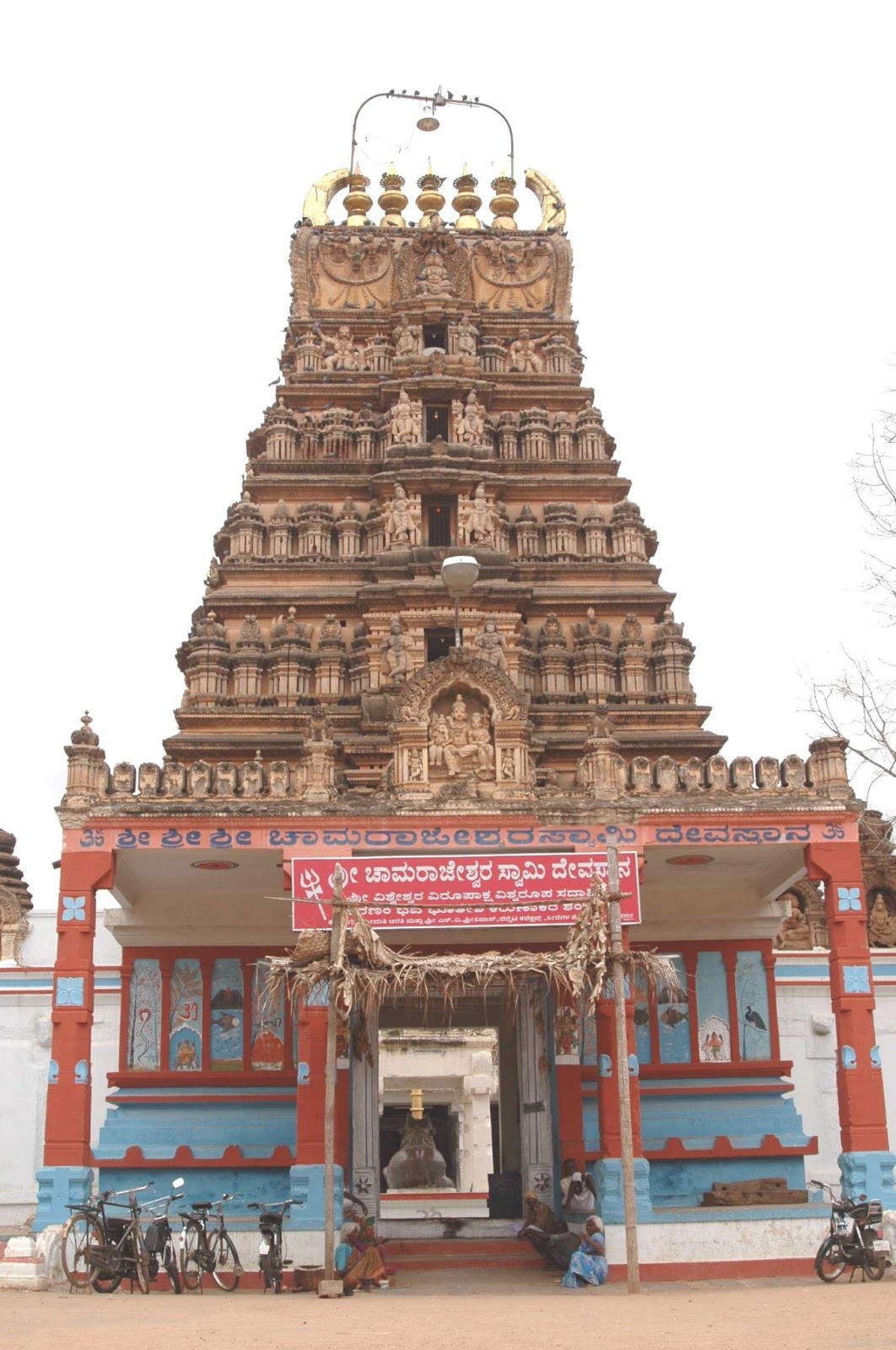
Chamarajeshwara Chariot Festival, Chamarajanagar

Chamarajanagar is a town in the southern end of Karnataka. It is also the headquarters of the Chamarajanagar district of Karnataka. It is named after Chamaraja Wodeyar IX (1774–1796), king of Mysore, who was born in the town.

Chamarajanagara was earlier called as ‘Hari Kutaara’ and later got the name Chamarajanagara because of God Chamarajeshwara Swami. 

 "Chamarajashwara" a historical and ancient temple that has been a great devotional boon to the people of Chamarajanagar and surrounding villages over the years, truly deserves its place in tourism map of Karnataka.  "Bhilvastakam" a Sanskrit chant praises Lord Shiva at Chamarajeshwara temple located in area of in the heart of Chamarajanagar town. 

HISTORY 


Maharaja Mummadi Krishna Raja Wodeyar

 The place was known by previous name "Arikotara"(Ari means enemy, Kotara means a Axe) and later it was renamed as Chamarajanagar after the birth of Sri Jayachamrajendra Wodeyar of Mysore Dynasty in 1776. The Chamarajeshwara temple was built in A.D. 1826 by Mummadi Krishna Raja Wodeyar in the memory of his father Sri Jayachamarajendra Wodeyar. The inscription - carved on a huge slab placed in front of the Janana Mantapa near Chamarajeshwara temple - gives information about the birth place of Sri Chamarajendra Wodeyar. The temple acquired prominence and fame during the period of Mummadi Krishna Raja Wodeyar of Mysore Dynasty. 


                  INSIDE THE TEMPLE


This temple has two mantapam’s – the Muukha-Mantapa (open pillered hall), the Nandi mantapam and Garbha Gudi (sanctum sanctorum). All the mantapams are carved with motifs of deities. At the entrance of the temple, the sitting Nandi Idol facing Lord Shiva is made of concrete, covered by an Iron Shield. A huge praakara (enclosoure wall) of the temple resembling a fort, covers the main temple comprising 64 idols and ancient deities. Inside the Sanctum of Lord Shiva temple, one can see Lord Snapana Ganapathi at Navarang and 6 lingas in a separate Chamber. Devotes after having a darshan of all the Gods inside the temple, report to the devotee of Shiva - Chandikeshwara to authorize the grace of Shiva. The “Navagraha’s” installed in front of Shiva temple attracts more number of devotees during Amavase(the new moon day). 


The more than 70ft high, 5 storey Rajagopura with 5 glittering brass "Kalasha " facing east is a wonderful specimen of the south Indian style of Hoysala architecture. The temple has big stage on either side in front of the temple. The stage witnesses the Cultural Utsav during the special occasions.

On either side of the main entrance of the temple, one can see the carvings of Lord Ganesha at left and Goddess Chamundeshwari at right. Mummadi Krishna Raja Wodeyar installed the Lord Chamarajeswara Linga in the memory of his father. Goddess Kempa-nanjambha in the memory of his mother resides to the left side of Lord Chamarajeshwara. But the historians and scholars assert that the temple was rebuilt by Mummadi Krishna Raja Wodeyar.

         Manuals say that the idols installed in the temple were brought from Balamuri temple in Srirangapatnam. The most characteristic and particularly interesting objects within the temple, are the paintings and stucco coloured images of Mythological instances taken from Girija Kalyana, Samudra Manthan (churning of sea to get Amrutha) and Goddess Chamundeshwari and Kempananjambha shrine. It is said that the images are maintained according to Mysore style by professional Palace artists belonging to Somavamsha Dynasty. 

 The color used for paintings were prepared by the Blue, Red and Yellow stones with a mixture of diamond Gum after crushing the stones to find powder. The color in stucco figures will last long time and can be witnessed even today at many temples in Mysore region including Chamarajeshwara temple. While a majority of the paintings are in a sad state of affairs some still carry the tinge of delicacy and softness, discernible only to shrewd eyes. 

 The temple was wealthy during the period Wodeyar Dynasty. Mummadi Wodeyar who visited the temple along with his three wives, is said to have presented all the valuable jewelry ornaments to the Lord Shiva. Even to this day, all the ornaments are kept in treasury and decorated during Girija kalyana celebration. Mummadi Wodeyar has donated the revenue of 13 villages to the temple to meet the expenditure incurred by the temple. But the income from the villages had been stopped due to the implementation of land reforms Act. Now a days, the temple income is said to have risen to Rs. 4 Lakhs per year, donated solely by the devotees. 


         CELEBRATIONS


Customary rituals and special aradhanas, poojas are conducted during the time of Shivarathri and Girijakalyana. Over thousands of devotees from other parts of the states witness the famous Chamarajeshwaraswamy Rathayathra celebrated with grandeur during the month of Aashada (July month) on every year. 


The Chamarajeshwaraswamy Ratha yathra is famous in this region because of the unique chariot fest celebrated during the month of Aashada (July Month). The Ratha yathra also has a special reference to the newly married couples. It is a custom normally followed in this region that the newly married couples must necessarily throw a pair of Banana fruit to the rolling chariot. The Rathotsava is also witnessed by many couples who have undergone child marriage, which is still being practiced in rural areas of Chamarajanagar District. 


The Rathothsava celebration takes place with an inclusion of other four Ratha’s, prominent of which includes Kempananjamba Ammanavara Ratha. The main chamarajeshwara ratha has a history of over 167 years. It is said that the main ratha was built by Basavaraje Urs of Urs Dynasty who served as a “bhakshi” in palace of Mysore Wodeyar in 1835.