Showing posts with label Significance. Show all posts

Tuesday, 22 January 2013

Scientific Importance of observing a fast on Ekadashi

From time immemorial, devotees have been observing fasts twice a month on the Ekadashi days. This fasting is, in general, for everyone. Ekadashi ('Eka' is 1, 'Dasha' is 10) is the 11th day in the lunar calendar, i.e. counting from the new moon day and also from the full moon day.

According to research, the air pressure in the earth’s atmosphere rapidly changes on both the new moon (Amavasya) and the full moon (Poornima) days. This is because of the orbital paths - combination of the sun, moon and the earth and their varying distances at particular intervals (i.e. every 24 hours for one entire rotation of the Earth). Accordingly the pressure in the atmosphere too changes drastically and varies from day to day.

This can be observed by the change in the nature of the tidal waves on the new moon and full moon days. On an Amavasya, the waves are very high and rough due to the increase in atmospheric pressure in the oceans. But from the next day onwards, the waves become calm - an indication that the pressure has also receded. Particularly on the 11th day from new moon or full moon days, the pressure is  very light or nil.

Now, based on this fact, the significance of Ekadashi fasting can be explained in this way -

1.    Compared to any other day of the moon cycle, atmospheric pressure is lowest on Ekadashi days. Thus, this is the best time to fast and cleanse our bodies. If we fast on any other day, the high pressure/strain may damage our system. On this day, the body never experiences the pain while we cleanse our systems, thus refreshing the entire body mechanism - specifically the liver/stomach/bowel.

As the atmospheric pressure builds up faster and doubles on the 12th day from Amavasya / Poornima days (called as Dwadashi), to avoid any complications in the body, people fasting are advised to consume food as early in the morning as possible, the next day.

2.    It is noted that fasting on this day is also very conducive to concentrate on meditation and prayers. According to science, it takes about 3-4 days for the brain to understand our food intake after we have eaten. It is said that if we eat light/fast on Ekadashi days, that intake will reach the brain correspondingly on the new moon/full moon day.


Health Benefits


Nowadays, people also fast for health reasons; fasting helps in the detoxification of the body. Everyone wants to look good by staying fit in the current times. As such, you may find many youngsters across India fasting. In the medical context, fasting refers to the state achieved after digestion of a meal. A number of metabolic adjustments occur during fasting and many medical diagnostic tests for blood sugar, cholesterol levels are standardized to fasting conditions. Thus fasting has medical reasons coated with religious significance in India.


1.    Cleansing of the bowels - Those who observe Fasting on Ekadashi days stay in good health, cleanse their bowel systems and are mostly free from frequent ailments. Also, it is said that for those on the spiritual/religious path, observing a fast on Ekadashi days, provides a mental peace, by way of self-realization. This sort of penance is believed to aid them in their spiritual path, thus making them pure in body and mind.

2.    Enforcing a better way of life - Fasting improves blood flow or circulation and the body's capacity to eliminate toxins, resulting in a better overall health. One feels more energetic and alert and is more resistant to all forms of disease or illness. It even slows down the aging process, which is a little more due to the accumulated effects of our bad habits or wrong ways of living. A day of fasting teaches one, self-control and discipline. It greatly helps to break those addictions that are destroying us and helps us start to acquire new and positive habits.

Now, let us look at the other scientific facts concerning the 11th day from the full moon & new Moon.

In the Indian Vedic system, there are different methods to calculate a month. One such is counting from the new moon day (Amavasya). From the new moon day till the full moon day it is called as Shukla Paksha (waxing/growing moon). From the full moon day till the next Amavasya, it is known as Krishna Paksha (waning/shrinking moon).

In the celestial phenomena, the Earth as well as moon rise and settle at the same time on Amavasya. From the next day up till Amavasya, the moon moves about a distance of 12 degrees from the solar path. On the Ekadashi day (11th day from full moon) the Moon stays at a distance of about 135 degrees in the solar path – this causes lesser gravitation force and thus resulting in lesser atmospheric pressure. Therefore fasting on an Ekadashi day will not affect the body system as also hunger is said to be minimum at this time.


ನ ಗಾಯಾತ್ರ್ಯಾ ಪರ ಮಂತ್ರಃ ನ ಮಾತೃ ಪರದೇವತಾ |
ನ ಗಂಗಾನ್ಯಃ ಪರಮಂ ತೀರ್ಥಂ ನ ಏಕಾದಶ್ಯಾಃ ಸಮಂ ವ್ರತಂ ||
lÉ aÉÉrɧrÉÉ mÉU qÉǧÉÈ lÉ qÉÉiÉ× mÉU SæuÉiÉÉqÉ |
lÉ aÉ…¡ûÉlrÉÈ mÉUqÉqÉç iÉÏjÉïqÉç lÉ LãMüÉSzrÉÉÈ xÉqÉqÉç uÉëiÉqÉç ||
 
Na GaayatryA para mantrah Na MAthru para dEvatA
Na GangAnyAh paramam theertham Na EkAdashyAh samam vratam


The rough translation: There is no mantra superior to the Gayatri mantra, There is no god superior to the Mother, There is no water more purifying or superior than River Ganges. And finally, there is no fast/ austerities (Vratha) more sacred or superior than the Ekadashi.
 

What can be consumed during Ekadashi?


Since the very purpose of the fast is to minimize bodily activities and to increase activities of devotion, prayer and peace, observers either abstain from completely or, at least, minimize the intake of food. Light meals of comprising of fruits, milk, milk products, vegetables, nuts, water and various non-cereal flours, fruits like banana, are eaten by those not undertaking a total fast. Grains and beans are avoided generally on the day of Ekadashi. These meals usually do not deliver the heavy bog-down feeling experienced after eating the same size meals cooked with grains and pulses. In general, onion and garlic are not consumed. In addition, cream, and heavy fat items are avoided on Ekadashi.

Apart from cleansing one's body bi-monthly, Ekadashi is also an excellent time to purify one’s mind and thoughts! Learning the scientific perspective of why Ekadashi is observed, can be an enriching experience. It is amazing how the ancient Vedic Indians devised this method to keep ourselves fit and free from any negative influences! 


Reference:

Wednesday, 9 January 2013

Gearing up for Sankranthi ...a guide to what you can do for the festival


Makara Sankranthi is the first festival after the New Year dawns, which most of us in Karnataka look forward to. It truly is 'Habbada Sadagara' at home and surely, we all have fond memories of the festival from our childhood days!

Many of us would recall preparations starting off weeks in advance. These days life has become so simple. Everything is available for the festival in the nick of time. Jaggery and coconut, cut into small squares, are available in stores and can be mixed at home. Even better (or worse?), we get ready made ‘Yellu bella’ mix at the neighbourhood grocery stores in India. Just buy them, pack and distribute it.

Yet, there is something beautiful about putting the ingredients together, ourselves. And that truly reflects our festive spirit in many ways.

Many of us would remember growing up watching our mothers (or grandmothers) 'passionately' cutting bella/jaggery and kobbari/coconut in front of 'eeligemane' (a knife jutting out of a wooden plank). This is a job which needs utmost patience. Hours would go by while you wait for these bella and kobbari to become crisp in the December sun! First week of January would go by making Sakkare achchu/sugar figurines. Closer to the day we neatly packed the Yellu bella mixture with sakkare achchu packets. Keeping these packets away from ants was another task!

On the day of Sankranthi we eagerly waited for the exchanged Yellu bella to taste them. We carefully opened each packet so that the sugar figurines were intact and beamed with joy if we got any special designs – animals, temples, trees, etc. Everyone in school had sakkare achchu in their lunch boxes, the entire month! 

This post is especially for those who live away from home, and reminisce about family and festivities. And of course, those for whom the homemade items always hold a special place. We will aid you with the preparations for this Makara Sankranthi!

Note that the below procedures are merely a guide towards what you can do to celebrate the spirit of the festival and in no way is a MUST for you to practice or follow.

In Karnataka, Makara Sankranthi is celebrated for 3 days. 

Bhogi habba


The first day is Bhogi habba (falls on 14th January this year) celebrated by the Tamilians and the Madhwa Brahmins. 


Thithi - Dvitiya
Nakshatra - Sravana

Things to be arranged prior to the festival


The houses are cleaned up and painted. Rangolis are drawn in the front yard. On this day, people decorate their homes. Old and unwanted things are burnt. Oil is applied to the hair, followed by a hair wash. Preparation of a special dish.


The grand feast comprises of delicious Huggi and Gojju. This is a dish prepared using Rice and split Green Gram with spices.


The Tamilians in Karnataka (and Tamil Nadu) prepare Pongal – a sweet dish made of milk and rice. Cooking is done in sunlight, usually in a porch or courtyard, as the dish is dedicated to the Sun god, Surya. The cooking is done in a clay pot which is decorated with colorful patterns. The prepared dish is served on banana leaves.

A huge bonfire of useless things in home is lit that is kept burning throughout the night.

In North Karnataka, on this day women begin the day by head bathing with ಎಳ್ಳು- ಅಕ್ಕಿ- ಅರಿಶಿನ mixture (which is considered beneficial for the skin during winter). ಅಕ್ಕಿ acts as scrub and the other two items have excellent antiseptic properties.Women also apply kajal to the eyes. Delicious food such as Sajji/Bhajra Roti is prepared on Bhogi.


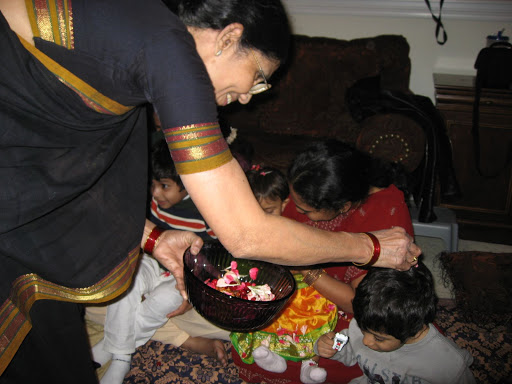
‘Kari Yeriyodu’ is a special ritual to be performed on the evening of Bhogi day. Children aged 5 and below in the house are dressed up in ornaments made of Kusuri Kalu and are made to sit on a mat. A mixture of puffed rice, berries (Yelachi hannu), Silver/Gold items, sugarcane pieces (kabbu), coins – and the latest additions - chocolates, sugar candy, coins are mixed and poured over their head to their delight (this mixture is also called ‘Bhogi Pandlu’). An aarathi is also performed for the little ones. The neighbours are invited to participate in this it. The significance of this ritual is to protect young kids from the evil forces.


Makara Sankranthi


The second day is Makara Sankranthi (falls on 15th January this year) for most folks in Karnataka.

Thithi – Tritiya
Nakshatra - Dhanishta

Things to be arranged prior to the festival
  • Cleaning of your house
  • Decoration of the house with mango leaves, flowers and rangoli
  • Sun roasting and fire roasting of sesame seeds, groundnuts, fried gram and coconut a week prior to the festival.
  • Preparation of the Yellu bella mixture, buying of sugar cane cut pieces, Yelachi hannu, bananas and Kusuri Kalu, making of Sakkare Achchu and a special dish (sweet Pongal, Huggi-Gojju, various rice items, etc).
  • Arrange the Puja Room – (if possible get an image or picture of God Surya) and the Neivedhya to offer to the God.


Process of Sankranti Puja
  • The puja is performed when the Sun enters Makara Rashi. Usually it is performed after sunrise - anytime until noon.
  • A special pooja is performed to the gods and an offering is made (Neivedhya).
  • Light the lamp. Usually a lamp with two wicks is lit on Makar Sankranti or two lamps can also be lit.
  • Start your prayers by remembering Lord Ganesha and next pray to Lord Surya.
  • For Puja you can break a coconut and place it on a tray along with betel leaves and betel nuts.
  • Place some flowers and rice mixed with turmeric powder before the idol of the deity in your puja room.
  • Place ‘Pongal’, a dish prepared from the recent rice harvest and distribute the Neivedhya.

The following items can be kept for the offering:
  • A mixture of Yellu bella (Sesame Seeds, Jaggery, Groundnuts, Fried Gram and Coconut)
  • Sakkare Achchu/Sugar candy moulds of various shapes
  • Sugarcane
  • Banana
  • Yelachi hannu/Jujube
  • Kusuri Kalu/Sesame Seeds coated with sugar
  • Sakkare Pongal/Sweet rice


In the evenings, young ladies (kids & teenagers) wear new clothes to visit friends, family and relatives with a Sankranthi offering in a plate, and exchange the same with other families. This ritual is called ‘Yellu Beerodu’. Here the plate would normally contain ‘Yellu’ (white sesame seeds) mixed with roasted groundnuts, neatly cut dry coconut & fine cut bella (Jaggery). The mixture is called ‘Yellu-Bella’. The plate also contains Sakkare Achchu with a piece of sugarcane. There is a saying in Kannada “Yellu bella thindu olle maathadi" which translates to 'eat the mixture of sesame seeds and jaggery, and speak only well.' This festival marks the harvest of the season, since sugarcane is grown predominantly in these parts.

In some parts of Karnataka, it is a practice that a newly married woman gives away bananas for a period of 5 years to other married women (‘muthaidhe’) from the first year of her marriage, with an increase in the number of bananas in multiples of five, every year. There is also a tradition of some households giving away red berries ‘Yelchi Kai’ along with the above. 

In some communities, if there is a new-born male child, then silver cups filled with fried savories are gifted to five women. It is also known that some communities gift silver idols of Krishna (if a male child) or of Aandal (if a female one).

In North Karnataka, people exchange Kusuri Kalu/Sesame seeds coated with sugar and greet one another with “Yellu bella thindu, Olle Maathu Aadu”. Popular dishes prepared here are ಹುಗ್ಗಿ  , ground nut holige , bajra rotti - all are sprinkled with  ಎಳ್ಳು. Bajji palya (mixture of all grains and vegetables), ಬದನಿಕಾಯಿ  ಭರ್ತಾ are also prepared. People check the local calenders to see which special dish to prepare for  bhogi every year.

If you are in the Karwar region you have an extraordinary celebration to plan for. Special poojas and colourful fireworks at Sri Krishna Mutt and other temples across the district create a traditional environment around the town of Udupi on the eve of  Makara Sankranthi festival on Friday January 14.  The festival is celebrated for seven days and so is called 'Saptotsava'. The temple street is filled with thousands of devotees to witness the beautiful celebration and take the blessings of the Lord.

During this festival Teppotsava is performed. After the night puja, Brahmaratha (of Lord Sri Krishna), Garudaratha (of Lord Hanuman), and Mahapuja ratha (with utsava murtis of Lord Ananteshwara and Lord Chandramouleshwara) chariots are pulled. This is followed by ‘Muru Teru Utsav’ programme. The most awaited ‘Teppotsava’ and the religious rites in Madhwa Sarovar in Sri Krishna Mutt and the colourful display of fireworks add to the specialty of the celebrations on this occasion.

Kanu Habba 


Also called 'Kari' in North Karnataka.

Thithi – Chaturthi
Nakshatra - Satabhisha

Things to be arranged prior to the festival -
  • A Rangoli in your front yard / in front of the main door.
  • A piece of fresh turmeric
  • Prepare red rice and yellow rice, using turmeric and kumkum
  • A Rangoli on the terrace
  • Turmeric leaves
  • Tamboola
  • Sugarcane bits
  • Arathi with turmeric powder and chunam (plaster made of shell-lime and sand)
Kanu Habba is celebrated mostly by the Tamilians. It is the third day of Sankranthi (falls on 15th January this year).  In the morning, a ritual takes place wherein turmeric is marked on the forehead of ladies and unmarried girls, by the gents and elders. The ladies seek their blessings for ‘sowmangalya’ and ‘to get a good husband’ respectively.

Red rice and yellow rice are prepared using turmeric and kumkuma. The turmeric leaves are arranged on the rangoli on the terrace and small balls made out of the pongal, red rice and yellow rice are arranged on the leaves. This is offered along with the tamboola and sugarcane to the Sun God. Finally, an aarathi is performed for the brothers with turmeric water & limestone and this water is poured on the rangoli in front of the house.

In North Karnataka, this festival is called 'Kari' - literally means black. This day is observed by a few and is believed to be inauspicious by some. Dishes fried in oil are prepared on this day. New born babies are showered with fruits/churmuri/sugarcane, in this region.

It is also a festival dedicated to cattle. People offer prayers to the bulls, cows and other farm animals as they are not only sacred, but also useful in daily life. On this day, which is Maattu Pongal for Tamilians, animals are decorated with colorful paper, bells and strings, their horns and hooves are painted with bright colours. They are raced on fire to mark the festival of Sankranthi and Kanu Habba.


Religious Procedures


From a religious viewpoint there are other things that one can do as a part of Makara Sankranthi:

1.  Observe Uttarayana Parva Kala: The Vedic meaning of Parva is said to be a Knot, a Confluence, and a Celebration. Based on the meanings, the time of confluence of two periods is called as Parvakala. Since the time of confluence of two seasons Dakshinayana and Uttarayana is considered to be very holy, auspicious and celestial and is called as Parva Kala.
It is said that during any Parvakala one has to take sacred bath, perform prayer, Japa, penance, and give Charity (Daana). Those who have lost their parents should also give Tarpana (libation) to their forefathers. This day one should desist from sensual pleasures, should not apply oil to the body/head, and should take only vegetarian food.

2.  Shat Tila karma: Scientifically, during winters one needs to consume food that generates heat in the body. Sesame seeds have oil in them that generates heat in the body. Even consuming jaggery during winters is considered good as it generates heat in the body. These items provide enough heat to the body needed during the winters. Sesame seeds are high in protein, fibre, vitamin B-complex, magnesium, calcium, iron and copper. They have one of the highest oil contents of any seed and are rich in vitamins and minerals.

It is said that on this day one should use Til (Sesame) seeds in six ways –

Tila Snana (application of sesame oil before a bath)
Tila Deepa (lighting of the lamp with sesame oil)
Tila Homa (or havan is a ritual in which making offerings into a consecrated fire is the primary action)
Tila tarpana ( a sacred ritual where the closest relatives make a sacred offering to the Gods so that the departed soul may enter heaven)
Tila Dana and bhakshana (charity of sesame)
Til used in food

Worshipping the Gods Narayana and the Sun is highly meritorious during this time. Paarayana of Vishnu Sahasranama sthothra, Aaditya Hridaya, Purusha Sooktha, Sri Rama Raksha Sthothra and Gayathri Japa, are useful prayers suggested at this time.

3.  Tila Dana: Donating Til seeds on this day with dakshina (any offering – clothes, fruits, money) is considered as very sacred and meritorious.

4.   Vasthra Dana: As per Masa dharma, being Pushya Masa donating clothes to a Brahmin is sacred and meritorious.

5.   Kushmanda Dana: Donating of Pumpkin on this day is also meritorious.


Note that the above procedures are merely a guide towards what you can do to celebrate the spirit of the festival and in no way is a MUST for you to practice or follow.

If you know of any ritual practice that has been missed out above – mail us with the details to the email ID below. We would love to hear what you have to say!

Write to: bangalorepress.blogspot.com

Our next post will provide you with mouth-watering recipes to prepare the most popular Makara Sankranthi dishes! 

Stay Tuned!